LG Washing Machine Repair in Kuwait: Diagnosis & Home Service
An LG washing machine may seem to be operating normally, then suddenly stop before the end of the program, leave water inside the drum, or spin much more weakly than before. The challenge is that one visible symptom can have several different causes, so proper repair should never begin by replacing a part immediately. It should begin with identifying the exact stage of the cycle where the failure occurs. In this article, we explain LG washing machine repair in Kuwait from a practical perspective connected to the problems users actually experience, how the washer should be inspected at home, when the issue may be simple, when a technician is needed, and what questions you should have answered before approving any repair or additional cost.
LG Washing Machine Repair in Kuwait
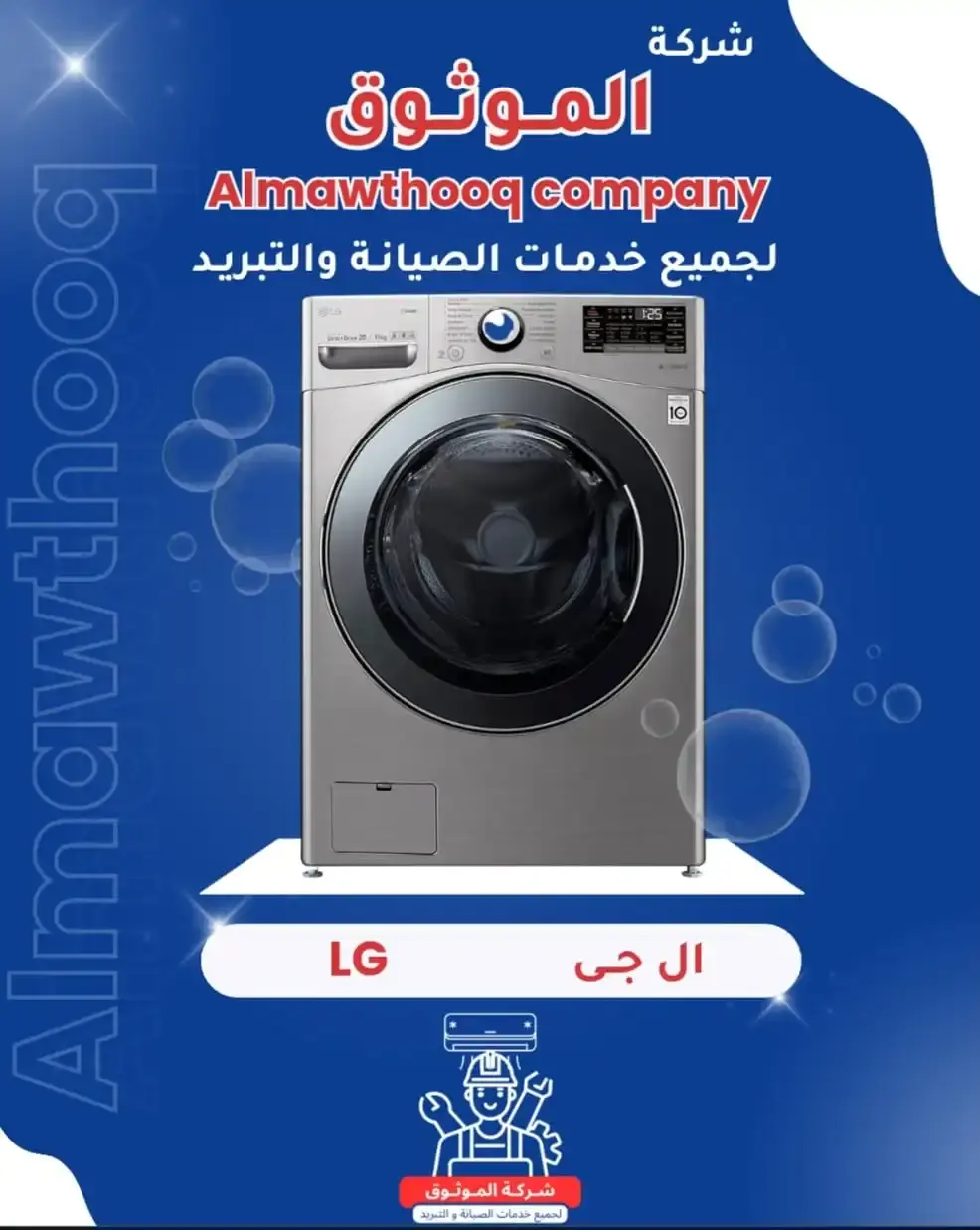
Proper LG washing machine repair in Kuwait should begin by identifying what changed in the washer’s behavior before it completely stopped or the fault became obvious. Modern washing machines do not operate as one isolated mechanical unit. Each stage depends on the successful completion of the one before it. For example, a user may report that the washer does not spin, while the real cause is that the machine failed to drain all the water first, which prevents the program from entering the spin stage correctly. In another case, the washer may stop during the cycle because the door or locking system did not provide the required confirmation signal, because water intake took too long, or because the load inside the drum became unbalanced. That is why professional diagnosis begins by identifying the stage where the washer stopped rather than looking at the appliance and immediately deciding that the motor or drain pump must be faulty.
During an organized repair, the technician should first review symptoms that can be seen or heard. Does the washer take in water within the normal time? Does the drum begin the wash movement? Does the water drain quickly? Is there an unusual sound during spinning? Does the fault appear on only one program or on every program? Each answer removes a group of possibilities and directs the inspection toward a more relevant system. This approach is especially important because replacing a part without testing can increase the cost and leave the customer paying for something that was never responsible for the original fault.
From practical repair experience, the information provided by the customer can sometimes be more useful than the error code itself. Saying that the washer “stopped” is not enough, but saying that it stops ten minutes after filling with water or that it drains only part of the water and leaves the rest inside the drum gives the technician something specific to work with. If the fault started after a power outage, moving the washer, or cleaning the filter, that detail should also be mentioned. Good repair should never depend on luck or random part replacement because the washer is an appliance, not a guessing game.
-
Identify the exact stage where the fault appears because a washer that stops after filling requires a completely different diagnostic direction from one that stops before spinning
-
Keep any error code unusual sound or change that appeared before the fault because the sequence of symptoms gives the technician a clearer picture than a general statement that the washer is not working properly
-
Do not approve replacement of an expensive component before knowing which test confirmed it as the cause because the same symptom can result from more than one component or operating condition
-
After repair the cycle that previously failed should be tested properly because a working display or a drum turning for a few minutes does not prove that the washer has fully returned to normal
LG Washing Machine Technician in Kuwait
Choosing an LG washing machine technician in Kuwait should depend primarily on the way the technician diagnoses the problem because real experience is shown through the questions asked and the order of inspection, not by how quickly the washer can be dismantled. A specialist will usually begin by asking whether the washer stops with water still inside, whether the drain pump can be heard, whether spinning is weak or completely absent, whether the drum moves normally during washing, whether the problem appears with every load or only with a blanket or another heavy item, and whether an error code appeared before the washer stopped. These questions help determine whether the issue is connected to drainage, load balance, drum movement, or the control process before any part is physically tested.
One important sign of a good technician is that they do not announce the most expensive possible diagnosis within the first few minutes. If someone says “the motor has failed” only because the drum did not move, it is reasonable to ask how that conclusion was confirmed. A drum can fail to move because operating conditions were not completed, the door lock was not recognized, water did not drain correctly, or another part of the cycle prevented movement. The same applies to the drain pump. Water remaining inside the drum does not prove that the pump itself is defective because a blockage, drain hose problem, or restricted path may create exactly the same result. An experienced technician works from simpler possibilities toward more complex ones and explains why each step is being checked.
It is also important to understand service pricing before work begins. The inspection fee is one thing, labor is another, and if a part needs replacement, that cost should be explained before installation. If the washer is older or has already required several repairs within a short period, a good technician should help you compare repair cost with the overall condition of the appliance rather than automatically recommending repair at any price. After the job is finished, the washer should be tested at the exact stage that originally failed. If the problem was drainage, drainage should be tested. If it was spinning, spinning should be tested. Turning the washer on for two minutes and declaring victory is not enough.
-
Choose a technician who asks about the timing of the fault and the sequence of the cycle before dismantling anything because understanding the behavior of the washer is more valuable than immediately naming a suspected part
-
Ask how the fault was confirmed and what test was performed because a specialist should be able to explain the reason clearly without hiding behind technical terminology
-
Agree on the inspection fee and the method used to calculate labor and replacement-part costs before repair so approval of any additional work is clear from the beginning
-
Make sure the technician tests the original problem after completing the work because successful operation in another stage does not prove that the reason for the service call has been fully corrected
LG Washing Machine Maintenance at Home
One of the main advantages of LG washing machine maintenance at home is that the technician can inspect the appliance under the same operating conditions where the fault actually appears. This is especially important when the problem is not caused by the washer alone, such as drain hose positioning, low water pressure, appliance stability, electrical supply, or the way hoses are installed behind the machine. A customer may complain about slow drainage and the actual cause may be a hose compressed between the washer and the wall. In another situation, strong vibration may come from poor leveling or an unevenly distributed load instead of a major internal fault. If the washer is moved somewhere else immediately, some of the conditions responsible for the problem may disappear and make diagnosis more difficult.
Good home maintenance should begin with the washer remaining in its original position as much as possible before the technician arrives, especially when the complaint involves noise, vibration, leakage, or slow drainage. The technician can then inspect the connections, the distance between the washer and the wall, the floor level, and the hose positions before running the appropriate program and observing the stage where the problem appears. If an internal component then needs inspection, there should already be a clear reason based on the external checks. This reduces unnecessary dismantling and preserves the original fault conditions instead of changing everything before diagnosis even begins.
Home service also saves the effort of transporting a heavy washing machine and reduces the risk of additional damage during moving. However, convenience is not the only advantage. The bigger benefit is that the repair happens in the same environment where the washer will continue operating afterward. That means the machine should be tested after repair while connected in its actual location, checking water intake, drainage, movement, and spinning according to the original complaint. If a larger repair or replacement part is required, the reason should be explained before work starts. Home maintenance is not simply a technician visiting the house. It means the installation environment itself becomes part of the diagnostic process.
-
Keep the washer in its normal location before the visit whenever possible because hose position appliance stability and the water source may be part of the cause of the fault
-
Clear enough space for the technician to reach the rear and sides without randomly changing the connections because seeing the original installation can help diagnose the problem
-
Do not dismantle internal parts before the technician arrives because changing wires components or their positions can hide the original condition and make diagnosis more difficult
-
After maintenance test the washer in the same location and on the same function that previously failed because service quality is measured by restored operation under real household conditions
LG Washing Machine Does Not Complete the Wash Cycle
When an LG washing machine does not complete the wash cycle, the problem cannot be understood from the word “stops” alone because the program consists of several connected stages and each one depends on the successful completion of the previous stage. One washer may take in water and begin washing, then stop before rinsing. Another may reach drainage and remain stuck there. A third may complete most of the program but never enter the final spin. Identifying the exact point where the cycle stops is the most important starting detail because it helps distinguish a problem with water intake, drainage, load balance, the door lock, movement, or control. A technician should not immediately replace the electronic control board simply because the program does not finish because stopping is the visible result while the real cause may be much simpler and located somewhere else.
During normal use, the issue may sometimes occur once because of a heavy load or poorly distributed laundry, then disappear after the clothes are rearranged. The situation is very different when the washer stops on every program or returns to approximately the same point in the cycle each time. Repetition itself becomes a useful clue, especially if water remains inside the drum, an error code appears, or the washer makes an attempted-start sound before stopping. If the washer can continue after being restarted, that should not be treated as a permanent fix. Restarting may begin the cycle sequence again, but it does not repair a cause that fails every time the appliance reaches the same stage.
Professional inspection should involve running an appropriate cycle and observing transitions between stages rather than testing the appliance empty for one or two minutes. The technician should confirm normal water intake, drum movement, drainage, and program execution in the correct order. If the fault is intermittent, your description of when and how it occurs becomes an important part of the diagnosis. Recording the program, approximate time, sound, or error code can significantly narrow the possibilities and make the repair more focused.
-
Record the exact stage where the cycle stops and whether water remains inside the drum because this information helps distinguish drainage problems from operating or cycle-transition faults
-
If the issue appears only with a heavy load try a normal medium-sized balanced load before treating the stopping as a permanent technical failure
-
Do not consider restarting the washer each time a solution if it repeatedly stops at the same point because the recurring behavior means the cause is still present
-
Save any code displayed on the screen and note which program was being used because combining the code with the timing of the stop provides stronger diagnostic information than the code alone
LG Washing Machine Does Not Drain Water
If an LG washing machine does not drain water and water remains inside the drum near the end of the program, the drain pump should not immediately be blamed. The drainage system includes several components and any blockage, hose restriction, or poor water path can create exactly the same visible result for the user. The first thing to inspect is the drain hose behind the washer and whether it is bent, compressed, or restricted, especially if the appliance was recently moved or the area around it was cleaned. Depending on the model, there may also be a user-accessible filter where lint or small objects from clothing pockets can collect. These items can slow drainage or stop it entirely, which is why the logical starting point is the drainage path before deciding that the pump itself has failed.
There is also an important difference between slow drainage and complete drainage failure. If water leaves the washer but moves very slowly, the program may take longer than normal or stop before the spin stage because the machine cannot lower the water level within the expected time. If no water leaves at all, observe whether the washer makes any sound during the drainage stage. Hearing the pump operate without seeing the water level decrease gives a different diagnostic clue from complete silence and no response. Even then, pump sound alone does not prove that the pump is healthy because it may be operating while the drainage path remains blocked or water movement remains too weak.
Safety is especially important with drainage problems because opening any drainage-related area while the washer contains water requires disconnecting the appliance from electricity and preparing for water release according to the instructions for the specific model. Do not tilt the washer randomly or dismantle internal parts without understanding the water path. A simple drainage fault can easily become a leakage or electrical problem through unsafe handling. If the user-accessible filter has been checked, the hose looks normal, and the problem continues, the technician should then test the pump and internal drainage path rather than continuing with random dismantling.
-
Observe whether water does not leave at all or drains only slowly because the difference changes the diagnostic direction and helps distinguish a partial restriction from complete drainage failure
-
Check the drain hose especially after the washer has been moved because compression or bending behind the appliance can stop normal flow even when the rest of the drainage system is healthy
-
If you hear operation during drainage but the water level does not decrease tell the technician because this provides a different clue from a situation where there is no response at all
-
Disconnect the washer from electricity before dealing with any user-accessible drainage part and avoid dismantling internal components because water and electricity leave no room for careless experimentation
LG Washing Machine Spin Problem
When an LG washing machine spin problem appears, the first thing is to distinguish between clothes coming out wetter than usual and the washer failing to enter the spin stage at all. Sometimes the reason is simple, such as selecting a program with a low spin speed or having an unbalanced load, especially when one blanket or heavy item is concentrated on one side of the drum. In that situation, the washer may repeatedly attempt to redistribute the laundry or intentionally reduce speed to protect the appliance. However, if the problem happens with normal everyday loads and different programs, the next question should be whether the washer completely drained the water before spinning because water left inside the drum can prevent the machine from reaching high spin speed and make the user assume the movement system is faulty when the real problem began with drainage.
It is also important to know whether the drum turns normally at low speed during washing and fails only at high-speed spinning, or whether movement is already abnormal from the beginning. The first situation directs the inspection toward the conditions required for high-speed operation, while the second creates a broader list of possibilities. Unusual sounds during attempted spinning are also useful clues. Grinding, heavy knocking, or the drum trying to accelerate and then stopping gives different information from complete lack of movement. That is why a technician should not hear “it does not spin” and immediately recommend a motor or another major part before understanding what is actually happening.
Overloading the washer repeatedly can affect spin results and place additional strain on movement and balancing systems, but that does not mean every spin fault is caused by the user. The washer should be tested with an appropriate balanced load after confirming drainage and settings. If everything is normal and high-speed spinning remains weak or absent, technical inspection should focus on the systems connected to that stage. After repair, an actual spin under suitable conditions should be tested because a drum turning slowly while empty does not prove that the washer can perform normally under real load.
-
Confirm the selected spin speed and program type because some cycles intentionally use a lower spin speed to protect fabrics and wetter clothes do not automatically mean a technical fault
-
Check whether all water has drained before blaming the spin system because incomplete drainage can prevent the washer from reaching the required high speed
-
Try a medium balanced load if the issue appeared with one large or heavy item because clothing distribution directly affects whether the washer can perform the spin stage correctly
-
If the drum washes normally but consistently fails during spinning with appropriate loads the inspection should focus on high-speed operation instead of replacing parts without testing
LG Washing Machine Fault Diagnosis
Proper LG washing machine fault diagnosis depends on collecting evidence in the correct order rather than memorizing a list of faults and assigning every visible symptom to a fixed part. The technician should begin with the customer’s description and then observe the appliance to determine which function fails to complete. If the washer does not drain, the drainage system should be checked. If it stops before spinning, water removal, load balance, and operating conditions should be reviewed first. If the drum does not move, the technician should determine whether the door has been recognized, whether the cycle has actually reached the movement stage, and whether there is any response or attempted movement. This method prevents the kind of rushed diagnosis where every problem suddenly becomes a motor or electronic-board failure without evidence.
One of the most useful things for diagnosis is remembering the changes that happened before the final fault. Did the washer become louder one week before stopping? Was drainage getting slower? Did the program begin taking longer? Did an error code appear and then disappear? These signs may reveal the development of the problem rather than only its final stage. The technician should also distinguish between a permanent and intermittent fault. A washer that fails on every cycle is different from one that stops only once a week, and an intermittent problem requires a precise description of the conditions under which it appears so the technician has a better chance of reproducing it during inspection.
From a trust and cost perspective, strong diagnosis should be able to prove why a proposed component is responsible for the problem. If the technician says the drain pump is faulty, they should explain what was checked in the drainage path and how the pump itself was confirmed. If the diagnosis is the motor, operating conditions and other causes of failed movement should already have been excluded. Each step should remove possibilities and move closer to the real cause. This makes the repair cost connected to evidence rather than to a series of expensive guesses.
-
Mention every sign that appeared before the final fault even if it seemed minor because changes in sound cycle duration or drainage speed may be part of the same developing problem
-
Distinguish between a fault that appears every cycle and one that is intermittent because the pattern helps the technician reproduce the problem and identify its cause
-
Ask which tests were used to eliminate other possibilities because good diagnosis should progress from simpler causes toward more complex ones instead of jumping to an expensive component
-
If several symptoms appear at the same time consider the possibility that they are connected because one original fault can create problems in later cycle stages and appear as several separate failures
LG Washing Machine Pump Repair
Proper LG washing machine pump repair should begin by confirming that the pump itself is responsible for the drainage problem because water remaining inside the drum or slow drainage does not automatically prove pump failure. A small object, lint buildup, a compressed hose, or another blockage somewhere in the drainage path can produce the same result. The pump itself may genuinely be weak or completely non-operational, but the difference must be established through inspection rather than assumption. A technician should first determine whether the washer is sending a drainage command, whether there is an operating sound, and whether water moves at all before deciding that the pump needs repair or replacement.
If the pump makes noise but water does not leave, there may be movement inside the pump while the drain path remains blocked or the pump may be operating weakly. If there is no sound at all, the technician should confirm that the pump is receiving the expected electrical supply or control signal before declaring it defective. This distinction matters because replacing a healthy pump while the real problem comes from a blocked path or control issue will not solve anything. The customer may then find the washer full of water again and wonder why the newly installed part apparently decided not to show up for work.
From an economic point of view, the cost of LG washing machine pump repair cannot be determined properly until the technician knows whether the solution involves cleaning, correcting a connection, repairing a limited issue, or replacing the pump. Inspection should therefore come before the final price, and the cost should be explained clearly before the work begins. After repair, the washer should be run through a real fill-and-drain sequence to confirm that water leaves at the expected rate and that the program can continue to spinning. Hearing the pump operate is not enough. The function of the pump is to remove water, not simply make noise.
-
Do not approve pump replacement before the drain hose and water path have been checked because a blockage can create the same symptoms even when the pump itself is capable of operating
-
Notice whether there is sound during drainage and whether any water movement occurs because this helps distinguish between a flow restriction and complete lack of pump response
-
Ask whether the work requires cleaning limited repair or actual component replacement because these situations involve different levels of labor and cost
-
After the work the washer should be tested for actual water removal and transition into spinning because successful drainage is measured by water leaving the machine rather than by pump noise alone
LG Washing Machine Motor Fault
An LG washing machine motor fault is certainly possible in some situations, but it should not become the first diagnosis simply because the drum does not move or the washer does not spin. Before reaching the motor, the technician should confirm that the washer has satisfied the conditions required for movement, including recognizing the door lock, reaching the correct water level, and progressing to the appropriate program stage. Failure to spin may also be connected to drainage or load balance, while complete lack of movement requires a different diagnostic approach. A specialist should determine whether the motor attempts to start, whether there is brief movement, unusual sound, or an error message, and then use the appropriate tests for the specific LG model rather than reaching a conclusion from the external symptom alone.
In some cases, the fault may involve another component within the motor-control system rather than the motor itself, which is why immediately replacing the main drive component can become unnecessarily expensive. If the drum moves during washing but fails to reach high speed during spinning, that already proves that movement exists under certain conditions and the technician should determine why it fails in a different stage. If there is no movement at all despite all operating conditions being satisfied, the list of possibilities becomes narrower. If a burning smell, abnormal heat, or strong rubbing sound appears, the washer should be stopped rather than repeatedly restarted because additional operation can increase damage.
The decision to repair or replace a major movement component should also consider the age of the washer, its overall condition, and the total repair cost. A relatively recent appliance in excellent condition with one clearly identified fault may justify repair, while an older washer with several simultaneous problems may require a different financial decision. The customer has the right to know what test confirmed the motor as the problem before approving a high-cost repair. After the work, the washer should be tested through washing and spinning with an appropriate load because a motor turning an empty drum slowly is not the same as normal operation under real household conditions.
-
Do not treat a stationary drum as final proof of motor failure before confirming door locking drainage and correct program progression because other operating conditions can prevent movement
-
If the drum moves normally during washing but fails only during spinning mention that clearly because it changes the diagnostic direction and proves the movement system works during at least part of the cycle
-
If lack of movement is accompanied by a burning smell or abnormal sound stop using the washer instead of repeatedly restarting it because continued attempts can increase damage to the movement system
-
Before approving a major motor-related repair compare cost with washer age and condition and ask for test-based evidence because expensive repair decisions should be supported by clear diagnosis
Booking an LG Washing Machine Repair Technician
Before booking an LG washing machine repair technician, prepare a few simple details that can make the service visit more productive and reduce diagnostic guesswork. If the model number is easily visible, have it ready. Take a photo of any error code and describe the problem in a specific way. Instead of saying “the washer is broken,” explain that it fills with water and then stops, completes washing but does not drain, or turns during the wash stage but fails to spin. If there is an unusual noise, leakage, or burning smell, mention that from the beginning. These details help the technician prepare the correct checks and make the first part of the visit based on useful information instead of general questions.
When booking, it is important to ask about the inspection fee, how repair cost is calculated, and whether the price will be explained before any replacement is made. A fixed inspection fee can be quoted in advance, but giving a final part-replacement price before diagnosis may be misleading because the same symptom can come from different causes. You should also ask whether any warranty is offered on the repair and exactly what the warranty covers, particularly if a part is replaced. A vague statement that “the repair is under warranty” is not enough if the actual terms are never explained.
Choose the technician based on clarity of communication, diagnostic approach, and the ability to test the appliance after repair rather than relying only on the lowest price or fastest arrival. If the washer has a major leak, burning smell, or severe rubbing sound, stop using it until the technician arrives. Disconnect it safely and leave the appliance in its normal position whenever possible so the original conditions can be inspected. After the work is completed, test the exact function that originally failed and make sure the program completes normally. A successful booking is not simply one where the technician showed up. It is one where you understood the cause, knew the cost, and saw the washer return to normal operation.
-
Prepare the model number a photo of any error code and a precise description of the stage where the fault appears because advance information helps the technician begin closer to the real cause
-
Ask about the inspection fee and the method used to calculate labor and replacement-part costs before approving the work because clear pricing keeps the repair decision under your control
-
If a repair warranty is offered ask how long it lasts and exactly what it covers because clear terms are more useful than the word warranty by itself
-
After service test the exact fault that caused you to call the technician because operation in a different stage does not prove that the original problem has been fully corrected
Conclusion
LG washing machine repair should never depend on replacing the first component commonly associated with a visible symptom. The correct approach is to identify the exact stage that fails during the wash cycle and connect it with the other functions around it. A washer that does not spin may actually have a drainage problem. A washer that does not complete its program may be failing in an earlier stage that prevents progression. Water remaining inside the drum does not automatically mean the drain pump is defective, and a stationary drum does not by itself prove a motor failure. The more organized the diagnosis is, the lower the chance of paying for a healthy component and seeing the same problem return afterward.
When you need LG washing machine repair in Kuwait, choose a technician who begins with inspection, explains the actual cause, gives clear pricing before repair, and tests the washer afterward under appropriate operating conditions. If there is leakage, a burning smell, strong noise, or abnormal movement failure, stop using the appliance instead of repeatedly restarting it. The real objective is not to force the washer through one successful cycle. The objective is to correct the underlying cause and restore stable filling, washing, drainage, and spinning without repeated visits and random repairs.
Frequently Asked Questions
Why does my LG washing machine stop before the program finishes?
The washer may stop because drainage did not complete, water intake was interrupted, the load became unbalanced, the door lock was not recognized, or another function prevented the program from moving to the next stage. Identifying the exact time of the stop and whether water remains inside the drum helps determine the correct diagnostic direction instead of assuming one fixed cause.
Does water remaining inside an LG washer mean the drain pump is faulty?
Not necessarily. A blocked drainage path, bent hose, or small object in a user-accessible drainage area can create the same result. The pump should be tested only after the drainage path has been checked before any decision is made to replace it.
Why does my LG washing machine wash normally but fail to spin?
The cause may be incomplete drainage, an unbalanced load, a low spin-speed setting, or a technical fault connected to high-speed operation. If the problem continues with a normal balanced load and the correct settings, the washer should be inspected rather than relying on an additional spin cycle every time.
Does a drum that does not turn mean the LG washer motor is damaged?
No. Lack of movement can result from several operating conditions or another fault that prevents the program from sending the movement command in the first place. The technician should confirm door locking, drainage, cycle progression, and the response of the movement system before identifying the motor as the cause.
When should I call an LG washer repair technician instead of trying to fix it myself?
If the problem continues after simple and safe user-level checks, repeats at the same stage, or is accompanied by leakage, a burning smell, severe rubbing noise, or complete loss of drum movement, professional inspection is the better choice. Random dismantling can turn one clear fault into several additional problems nobody asked for.