Toshiba Washer Repair: Common Faults & Home Technician Service
A Toshiba washing machine problem may begin with something small, such as slower drainage or clothes coming out wetter than usual, and then develop into a complete stop during a certain stage of the cycle. That is why Toshiba washing machine repair in Kuwait should not begin by immediately replacing a component. It should begin by understanding the sequence of the wash cycle and identifying the exact function that is no longer working the way it used to. In this article, we focus on Toshiba washing machine faults from a practical and independent angle, explain how to distinguish between a simple operating issue and a problem that needs a technician, what information is useful during a home inspection, and how to avoid paying for a motor or drain pump before the real cause of the fault is properly confirmed.
Toshiba Washing Machine Repair in Kuwait

Toshiba washing machine repair in Kuwait becomes much more accurate when diagnosis begins with the way the washer behaves during the cycle because a fault that appears to the user near the end of the program may actually have started one full stage earlier. For example, if clothes come out much wetter than usual, some people immediately assume the spin system is faulty. However, if the machine failed to drain the water within the expected time, it may reduce spin speed or avoid entering the spin stage completely. In the same way, a washer that stops after filling with water requires a different inspection from one that washes normally and then becomes stuck during drainage. Every situation needs its own diagnostic direction. That is why a professional technician does not treat the phrase “the washing machine is broken” as a diagnosis. Instead, they turn it into a group of observations that help identify exactly where the wash cycle stopped progressing normally.
One of the most useful things you can do before any dismantling is observe the appliance through as much of a full program as possible. Does water enter at the usual speed? Does the drum move during washing? Can you hear the washer clearly transitioning to the drainage stage? Does it attempt to spin and then stop? Does an error code appear, or do you notice a new light pattern or sound? These details can save the technician from unnecessary trial-and-error checks and allow the inspection to begin much closer to the actual cause. If the fault does not appear on every cycle, it is also important to identify the conditions that make it return, such as a heavier load, a certain program, or running several cycles close together.
From a repair-cost perspective, inspection should always come before the final diagnosis. There is a significant difference between a simple blockage in the drainage path, a weak drain pump, and a fault related to movement or control. If a replacement component is recommended, ask what test confirmed that it is actually defective. Washing machine repair should never turn into a parts auction. The more organized the diagnosis is, the lower the chance of replacing a perfectly good component. After the repair, the specific function that originally failed should also be tested properly because a drum turning for two minutes does not prove that drainage, spinning, and the complete program are all operating normally again.
-
Observe the exact stage where the problem begins instead of describing the washer only as stopped because fault timing helps narrow the possibilities before any component is opened or removed
-
Keep any error code unusual sound or change in program duration because several connected signs usually give the technician a more accurate picture than one isolated symptom
-
Do not approve motor or drain-pump replacement simply because the symptoms resemble a previous fault because the same result can come from completely different components or operating conditions
-
Ask for a full-cycle test after repair especially around the stage that previously failed because successful operation in one part of the program does not prove the whole washer is stable again
Home Toshiba Washing Machine Technician
Choosing a home Toshiba washing machine technician should depend more on the inspection method than on how quickly someone can arrive because the real value of the visit is not simply that a technician reaches your home. It is whether they can connect your description of the problem with the actual behavior of the appliance. A good technician starts with specific questions: Is the problem constant or intermittent? Does the washer complete the wash stage but fail during spinning? Does water remain inside the drum? Is there a sound just before the washer stops? Did the fault begin after the appliance was moved, after a part was cleaned, or following a power interruption? These questions matter because they help distinguish between a problem connected to installation or usage conditions and an internal fault that genuinely requires testing and measurement.
One major advantage of a home technician is that the washer can be inspected in its normal position with the original hoses and connections still in place. This is especially important for drainage, vibration, and water-intake problems. The washing machine itself may be healthy while the drain hose is sharply bent behind the appliance, or strong vibration may be caused by poor leveling on the floor. In another case, low water pressure may delay the program even though the washer’s internal components are working correctly. If the machine is moved before inspection, some of these signs may disappear and the technician may start searching inside the appliance for a fault that actually comes from the installation environment.
Another sign of a trustworthy technician is that they do not rush to open the machine or immediately blame the most expensive part. If the technician says the motor is faulty, they should be able to explain why drainage, locking, and control conditions were ruled out first. If they say the drain pump is faulty, they should show that the water path itself is clear. You also have the right to know the visit fee and how repair pricing is calculated before any work starts. If more than one problem is discovered, the issues should be prioritized according to their actual effect rather than replacing everything at once. After the repair is complete, the washer should be tested in its original position to make sure water intake, drainage, and spinning all operate as expected.
-
Choose a technician who asks about the sequence of the fault before dismantling the washer because the stage where the problem begins helps identify the cause instead of encouraging random part replacement
-
Keep the washing machine in its normal location before the visit whenever possible because hose position floor level and water connections may be directly related to the fault
-
Ask why each proposed replacement part is needed and how it was tested because a specialist should be able to explain why a component is confirmed as faulty rather than simply saying it probably failed
-
After the service test the washer in its real installation position because successful operation after changing hoses or moving the machine does not prove it will perform correctly during normal everyday use
Toshiba Automatic Washing Machine Maintenance
Toshiba automatic washing machine maintenance is different from waiting until the appliance completely breaks down because good maintenance is about noticing changes in performance before a small problem develops into a clear operating failure. For example, if drainage starts taking longer than usual, the washer sounds different during spinning, or the same type of load begins coming out noticeably wetter, these are signs worth monitoring even if the program still finishes. The idea is not to dismantle the washer on a schedule for no reason. It is to understand what is normal for the appliance and what has changed because gradual changes can sometimes give you the chance to deal with the cause before another component is affected.
Practical maintenance begins with the safe checks the user can perform according to the design of the washer. That can include inspecting external hoses for bending or pressure behind the appliance and checking any user-accessible cleaning areas if they exist on the specific model. Load size also deserves attention because repeatedly putting more laundry into the washer than it is designed to handle can place extra strain on movement and balancing systems and reduce spin performance. At the same time, it is important not to turn every fault into “user error.” If the same problem continues with an appropriate load and the correct settings, then the washer needs a genuine technical inspection.
A common mistake is repeatedly running the washer again whenever a cycle takes longer, or increasing detergent quantity in the hope that the result will improve. The actual issue may be drainage, drum movement, or the transition between program stages. Excessive foam itself can also affect the behavior of some cycles depending on the washer and detergent type, so using the correct quantity is more useful than adding extra. If you notice a burning smell, strong grinding noise, or obvious water leakage, routine maintenance is no longer enough. The washer should be switched off and inspected by a technician. Good maintenance is partly about knowing what can be cleaned or checked safely and partly about recognizing the point where preventive care has reached its limit.
-
Monitor any noticeable increase in program duration or slower drainage because gradual performance changes may be the first sign of a fault that later causes the washer to stop completely
-
Use an appropriate load size and the correct detergent quantity according to the appliance instructions because repeated overloading or excess detergent can affect movement spinning and program behavior
-
Inspect external hoses after the washing machine has been moved because even a simple bend or compression behind the appliance can create operating problems without any internal failure
-
If you notice strong grinding a burning smell or obvious leakage stop using the washer and do not treat the situation as routine maintenance because those signs need direct technical inspection
Toshiba Washing Machine Does Not Spin the Laundry
When a Toshiba washing machine does not spin the laundry, the first step should not be to assume that the motor has failed or that the spin system is completely damaged. You first need to know whether the machine actually reached the spin stage under normal conditions or stopped before that because of another problem. In many cases, the washer will not enter high-speed spinning if it has not drained all the water or if the load inside the drum is badly unbalanced. In other words, you may see extremely wet clothes and assume there is a spin fault while the real cause actually began during drainage. Selecting a program with a lower spin speed or washing one large heavy item such as a blanket can also produce a different result from normal daily laundry.
The important detail is how the drum behaves before spinning. If the drum moves normally during washing and rinsing but fails to reach high speed at the end, that is completely different from a washing machine where the drum never moves at all. If you hear the machine attempting to accelerate, then slowing down and repeatedly redistributing the load, the system may be trying to correct imbalance before spinning. On the other hand, a strong grinding sound, heavy knocking, or repeated stopping at exactly the same point makes technical inspection more important.
In practical terms, first try a medium-sized load distributed normally and confirm that the water has fully drained before assuming a spin-system fault. If the problem continues across different programs with a reasonable load, the technician should inspect the spin stage and the parts involved in movement and control rather than immediately replacing one component. After repair, an actual spin cycle should be tested with a suitable load because a drum turning slowly while empty does not prove the problem has been solved. The real goal is for clothing to come out with the normal moisture level and for the washer to complete the program without stopping or repeatedly trying to rebalance the load.
-
Confirm that all water has drained before blaming the spin system because water remaining inside the drum can prevent high-speed spinning even when the movement system itself is healthy
-
Try a medium-sized balanced load if the problem happened with one large heavy item because poor load distribution can make the washer reduce speed or keep trying to rebalance instead of performing a full spin
-
Notice whether the drum moves normally during washing but fails only during spinning because this detail changes the diagnostic direction and prevents a rushed motor diagnosis
-
If there is strong noise rubbing or repeated stopping as spinning begins avoid restarting the washer many times because repeated attempts may place additional strain on movement-related components
Toshiba Washing Machine Does Not Drain Water
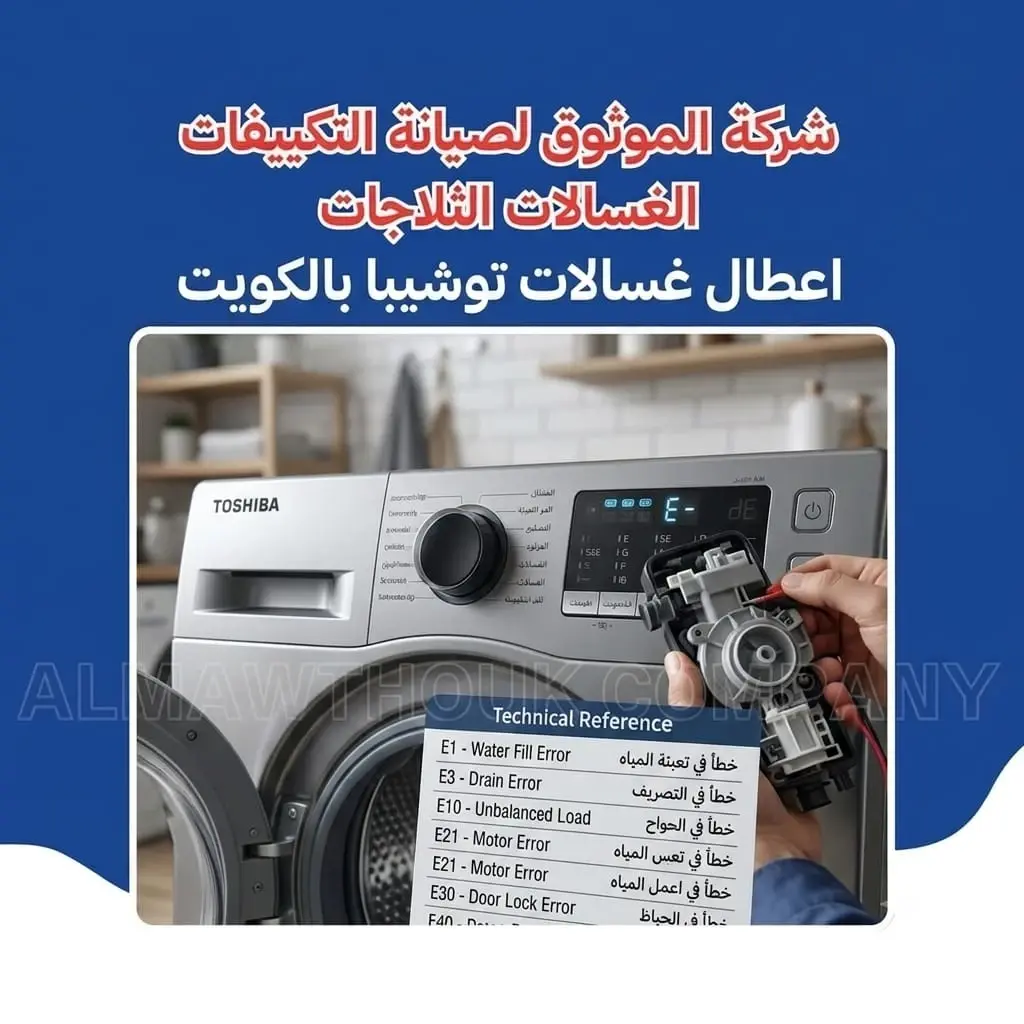
If a Toshiba washing machine does not drain water and a noticeable amount remains inside the drum after the program ends or before spinning begins, the inspection should start with the entire drainage path rather than the drain pump alone. The drain hose may be compressed behind the washer or bent after the appliance was moved. There may also be a blockage in a user-accessible cleaning area depending on the model, or a small object from a clothing pocket may have entered the drainage path. All of these problems can create exactly the same visible result for the user: the washer stops and water stays inside. However, the correct repair depends entirely on the real source.
It is also necessary to distinguish between a washer that does not drain any water at all and one that drains very slowly. If drainage is slow, the program may run longer or stop before spinning because the water level is not dropping quickly enough. If there is no drainage at all, pay attention to whether you can hear the washer attempting to drain. Hearing sound from the pump area while the water level remains unchanged points the diagnosis in a different direction from a completely silent washer with no response. Even then, sound alone does not prove the pump is healthy because the pump may be operating but unable to move water due to a blockage or because its performance has weakened.
If your washer has a user-accessible drainage filter or similar part, it should only be handled according to the instructions for the model, after disconnecting the washer from electricity and preparing for water to come out. Do not tilt the washer randomly or dismantle an internal hose without understanding the system because that can cause a larger leak or allow water to reach electrical components. If the visible hose and safe user-accessible areas have been checked and the problem continues, the technician should inspect the drain pump, internal drainage path, water level conditions, and control system. Correct diagnosis prevents replacing a pump when the real problem is only a blockage or repeatedly cleaning a hose when the pump itself has actually lost performance.
-
Determine whether drainage is completely stopped or simply very slow because the difference helps the technician identify whether the problem is closer to a partial blockage or a pumping-system failure
-
Check the drain hose from the outside after the washing machine has been moved because pressure between the appliance and the wall may restrict water flow even when the internal parts are operating normally
-
If you hear the washer working during drainage but the water level does not fall mention that clearly because it helps narrow the possibilities between the pump and the drainage path
-
Disconnect electricity before opening any user-accessible drainage area and avoid inserting random tools internally because water leaking around electrical components can turn a simple fault into a much larger problem
Common Toshiba Washing Machine Faults
Understanding common Toshiba washing machine faults does not mean connecting every symptom to one fixed component and following a memorized fault chart. One washing machine can produce the same final symptom for several different reasons. Problems commonly noticed by users include a cycle that stops, weak spinning, water remaining in the drum, unusual noise, strong vibration, delayed water intake, or slow drainage. The real value comes from understanding how these symptoms connect to one another. For example, weak spinning and water remaining in the drum should often be evaluated together because drainage may be the original problem while spinning is simply the later stage that was affected.
Sounds also provide different information depending on when they appear. Heavy knocking during spinning with a very large load may be connected to imbalance or poor leveling, while a constant rubbing sound even with a light load needs a different inspection path. A washing machine that stops after filling with water points toward a stage that is not being completed, while a washer that stops near the end of the program raises different possibilities. That is why the most useful thing you can do before the technician arrives is record when the fault happens and what happens immediately before and after it. This turns a vague complaint such as “the washer is acting strange” into information that can actually be diagnosed.
Another mistake that can increase repair cost is hearing that someone else had the same symptom and their washer needed a control board or motor, then assuming your appliance must have the same fault. Even if the model is similar, the cause must still be confirmed through inspection. The same applies to error codes. Not every code automatically names one failed component. In many cases, the code points toward a function or operating condition that needs to be checked according to the washer design. A good technician combines the code with cycle behavior and testing instead of treating the display as though it is directly naming the replacement part. This approach greatly reduces unnecessary component replacement.
-
Connect symptoms instead of treating every sign as a separate failure because one drainage problem for example can appear to the user as both program stopping and weak spinning
-
Record when noise or vibration begins and whether it changes with the load because timing and operating conditions help distinguish a usage-related issue from a part that needs inspection
-
Do not transfer a diagnosis from another washing machine to your own appliance even if the symptom looks similar because model condition and usage can make the real cause completely different
-
Use display codes as diagnostic guidance rather than a final verdict on one component because reliable diagnosis combines the code with appliance behavior and technical testing
Toshiba Washing Machine Motor Repair
Toshiba washing machine motor repair should be the result of a confirmed test, not the starting point of diagnosis simply because the drum did not move. The motor is a major component and can be expensive compared with simpler causes that may prevent movement, so before focusing on the motor, the technician should confirm that the program actually reached the movement stage, that the door or lid lock was recognized, and that water intake or drainage conditions did not prevent the cycle from progressing. It is also important to know whether the drum never moves at all or moves during washing but fails only during spinning because this difference significantly changes the diagnosis.
If the drum moves slowly during the wash stage, that already proves the movement system is capable of operating under some conditions. A failure only during high-speed spinning therefore needs a more specific explanation instead of simply declaring that the motor is “dead.” If there is no movement from the beginning despite all the other operating conditions being satisfied, the technician should inspect power supply, motor response, and the control components associated with movement according to the model. A burning smell, severe noise, or unusual heat during an attempted start is a reason to stop the machine rather than repeatedly restart it.
From an economic perspective, if a major motor or motor-control fault is confirmed, repair cost should be compared with the age and general condition of the washer. A machine in excellent overall condition with one clear fault is different from an older washer that already has drainage, noise, and leakage problems at the same time. You also have the right to ask what test confirmed the motor-related problem and whether the main motor actually needs replacement or whether another connected component is responsible. After repair, both washing and spinning should be tested with a suitable load because an empty drum turning without resistance is not the same as real operation under normal household conditions.
-
Do not treat a drum that does not move as sufficient proof of motor failure before checking operating conditions and program progression because several other faults can prevent the movement command from being issued
-
If the drum moves during washing but fails only during spinning mention that clearly because movement in one stage changes the diagnosis and may prevent unnecessary replacement of the main motor
-
Stop using the washer if a burning smell unusual heat or strong grinding sound appears when movement is attempted because repeated operation can increase the damage
-
Before approving an expensive repair ask for the test result and compare the cost with washer age and condition because a motor-related decision should make both technical and economic sense
Toshiba Washing Machine Drain Pump Fault
Diagnosing a Toshiba washing machine drain pump fault requires separating three different possibilities: the pump may not operate at all, it may operate but have weak performance, or it may be working while water cannot move through the system because of a blockage. From the user’s point of view, all three cases may look very similar because the final result is water left inside the drum and a program that slows down or stops. For a technician, however, each situation requires a different test. That is why water remaining inside the washer is never enough by itself to justify installing a new drain pump.
One useful sign is the sound produced during the drainage stage. If you hear humming or rotation but water moves slowly or does not move at all, there may be an obstruction or the pump may have lost part of its ability to move water. If there is no sound whatsoever, the technician needs to confirm that the pump is actually receiving the operating command and the required power before declaring it defective. This is where proper diagnosis becomes important because replacing the pump when the real fault is in the control system or drain hose will not solve the problem, and the washer will still be left full of water afterward.
Cleaning a filter or another user-accessible drainage area may solve the issue if the cause is a small object or accumulated lint, but it should be done safely. Force or sharp tools should not be used inside the pump path because the impeller or housing can be damaged. If the pump is genuinely replaced, a full drainage test should then be performed to make sure water leaves at a normal rate and that the washer can transition into spinning correctly afterward. A successful drain pump is not one that simply makes a sound again. It is one that removes water within the expected time.
-
Distinguish between a completely silent pump and a pump that makes noise while drainage remains weak because each condition points toward a different diagnostic path before replacement
-
Do not ignore the possibility of a filter or hose blockage because a small object can restrict drainage and produce symptoms that look exactly like pump failure
-
If pump replacement is recommended ask whether the operating command and drainage path were checked first because a new pump cannot solve a problem that actually exists somewhere else
-
After repair judge the result by actual water removal and successful transition to the spin stage because pump sound alone does not prove the service was successful
Toshiba Washing Machine Repair at Home
One of the biggest advantages of Toshiba washing machine repair at home is that the technician can inspect the appliance in the real environment where the problem occurs instead of separating it from conditions that may actually be part of the fault. Drain hose position, water pressure, floor level, space behind the washer, and the electrical connection can all influence operation. Strong vibration may come from poor leveling rather than an internal mechanical problem, while slow drainage may be caused by a hose trapped behind the machine. If the washer is moved somewhere else before inspection, some of these clues may disappear and everyone may start searching inside the appliance for a fault that was never there in the first place.
During a home visit, it is better to leave the washer as close as possible to the way it was when the problem appeared, provided there is no safety risk. If there is leakage or a burning smell, disconnect the appliance and wait for the technician. If the problem is cycle stopping or weak spinning, leave the hoses and connections in place instead of changing their height or position before inspection. The technician should first review the external installation, then run an appropriate program and observe the stage where the fault appears before deciding whether any internal part needs to be opened.
Home service also provides the opportunity to test the repair under exactly the same conditions after the work is complete. If the problem involved drainage, the hose and actual water flow can be monitored. If it involved spinning, appliance stability and a suitable load can be tested. If a new component or additional work is required, the cost should be explained before the repair begins. Home repair does not mean every possible job must be completed automatically in one visit. It means the diagnosis happens in the correct environment and in an organized way so you understand what was repaired and why.
-
Keep hoses and connections in their original position before inspection whenever there is no safety risk because changing them may hide an installation-related cause and make the fault harder to reproduce
-
Clear enough space around the washer so the technician can inspect the back and sides without pulling hoses or changing connections unnecessarily
-
Ask for an appropriate test cycle before and after the repair because comparison in the washer’s real installation position provides clearer evidence that normal performance has returned
-
If another fault is discovered during the visit ask for a separate explanation and price before approving it because the technician being present does not mean every additional repair should automatically be carried out
Booking a Toshiba Washing Machine Fault Technician
Before booking a Toshiba washing machine fault technician, prepare a short but accurate description instead of simply saying that “the washing machine has stopped.” Try to identify the last stage that still works normally, whether water remains inside the drum, whether there is a sound, error code, or unusual vibration, and whether the problem appears every time or only with a certain program or load. If the model number is easy to find, have it ready or take a photo because different models may use different access methods and fault indications. Every useful detail you provide before the visit can save time at the beginning of the inspection.
When booking, ask what the visit fee includes and whether it covers inspection only or includes any basic maintenance. Also ask how labor and replacement-part costs are calculated if repair is needed. It is not useful to enter the visit expecting one type of service while the technician is expecting something completely different. If the fault is more serious, such as a burning smell or complete loss of drum movement, mention that from the start so the technician understands that the visit is for fault diagnosis rather than routine cleaning. If any repair or replacement part comes with a warranty, ask how long it lasts and exactly what it covers instead of relying on a vague promise.
Choose the technician based on clear communication and diagnostic method, not only the fastest appointment or lowest number. A technician who asks about the cycle sequence and then explains what was found after inspection gives you more confidence than someone who identifies a replacement part over the phone. After the service, ask for the original fault to be tested again and get a short explanation of what caused the problem and what signs would justify another check in the future. A successful booking is not simply one where the technician arrives with a toolbox. It is one where you understand the cause, know the cost, and see the washing machine return to normal operation.
-
Prepare the model number and a clear description of the stage where the fault repeats because advance information helps the technician reach a more accurate diagnosis more quickly
-
Ask about the inspection fee and exactly what the price includes before confirming the booking because a clear service scope prevents disagreement once the work begins
-
If there is a burning smell leakage or severe abnormal noise mention it clearly while booking and stop using the washer because these signs require faster attention than ordinary maintenance
-
After repair ask for the original problem to be tested and request a short explanation of the cause because the best service leaves you understanding what happened rather than only holding an invoice
Conclusion
Toshiba washing machine repair requires organized diagnosis that starts with understanding the exact stage where appliance performance changed. Weak spinning may begin with a drainage problem, water remaining inside the drum does not automatically mean the drain pump is defective, and a drum that does not move is not final proof of motor failure. The more the symptoms are connected to the actual sequence of the wash cycle and the simpler possibilities are checked before expensive components, the lower the chance of replacing a healthy part or paying for unnecessary work.
If you need Toshiba washing machine repair in Kuwait at home, choose a technician who reviews the installation conditions, explains which test led to the diagnosis, and gives you the repair cost before the work begins. In cases involving obvious leakage, a burning smell, strong abnormal noise, or unusual loss of drum movement, stop using the appliance rather than repeatedly restarting it. The goal is not simply to make the washer complete one successful cycle after the visit. The real objective is for drainage, movement, spinning, and the remaining program stages to return to stable normal operation without the same problem returning again shortly afterward.
Frequently Asked Questions
Why does my Toshiba washing machine wash but not spin?
The cause may be incomplete drainage, an unbalanced load, a low spin setting, or a technical problem connected to the high-speed spin stage. If the issue continues with an appropriate load and normal drainage, the technician should inspect the spin stage instead of assuming one specific cause.
Does water remaining inside a Toshiba washer mean the drain pump is faulty?
Not necessarily. The drain hose may be compressed, there may be a blockage in the drainage path, or a filter may need cleaning depending on the model. The drain pump should only be judged after confirming that the water path is clear and that the operating command is reaching the pump normally.
When is a drum that does not turn a sign of a motor problem?
If the washer has met all normal operating conditions and the drum still does not move, then the movement system and motor become important areas to inspect. However, door locking, drainage, and program progression should be ruled out first because each of these can prevent drum movement before the motor is even commanded to run.
Is it better to take a Toshiba washing machine to a workshop or inspect it at home?
Many faults can begin with an effective home inspection because the technician can see the hoses, floor level, water pressure, and connections in their actual operating condition. If the problem later requires work that cannot be carried out safely at home, the appropriate next step can be decided after diagnosis.
When should I stop using my Toshiba washer and call a technician immediately?
If you notice a burning smell, obvious water leakage, strong grinding or rubbing noise, or abnormal drum stopping, disconnect the washer from electricity and stop using it. Repeated operation under these conditions may turn a limited fault into more serious damage.